

One of the most common questions business owners ask when planning their SEO strategy is simple: “Should I focus on local SEO or national SEO?”
It’s a fair question, and honestly, there’s no one-size-fits-all answer. The right approach depends on your business model, your target audience, and where you are in your growth journey. Choosing the wrong strategy can mean wasted budget and slow results — while choosing the right one can accelerate your growth significantly.
In this guide, we’ll break down exactly what local and national SEO involve, how they differ, and how to figure out which one (or combination) makes sense for your business right now.
What Is Local SEO?
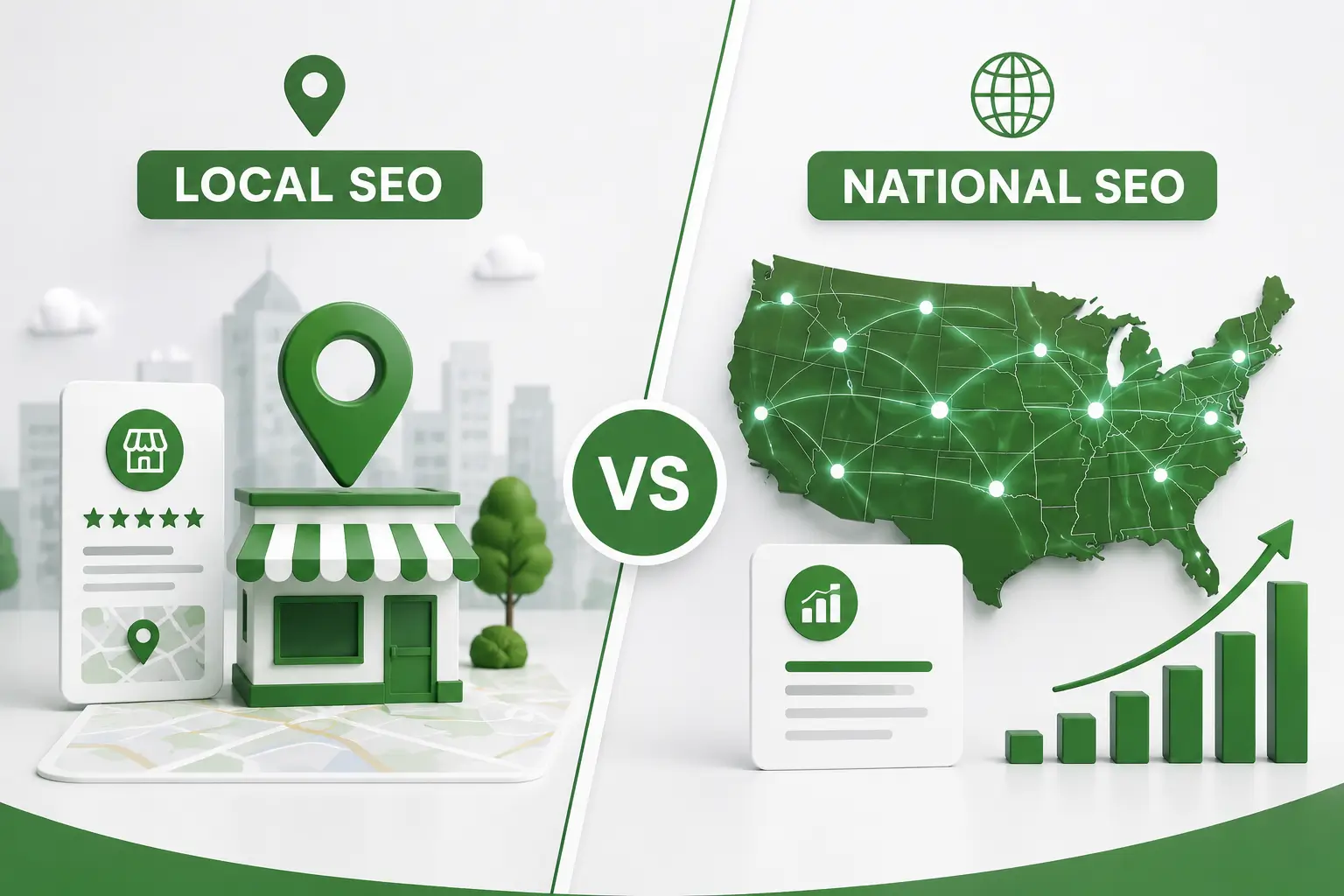
Local SEO focuses on improving your visibility for searches tied to a specific geographic area. Think of searches like “plumber near me,” “best coffee shop in Manchester,” or “digital marketing agency in Austin.”
Local SEO is essential for businesses that serve customers within a defined area — think restaurants, law firms, dentists, home service providers, and local retail stores.
Key Elements of Local SEO
- Google Business Profile optimisation — ensuring your listing is complete, accurate, and regularly updated
- NAP consistency — your Name, Address, and Phone number must match exactly across all directories and platforms
- Local citations — listings on directories like Yelp, Bing Places, and industry-specific platforms
- Localised content — pages targeting specific cities, neighbourhoods, or regions
- Customer reviews — a strong volume of positive, recent reviews significantly impacts local rankings
- Local backlinks — links from local newspapers, business associations, or community websites.
What Is National SEO?
National SEO focuses on ranking for broader, non-location-specific keywords across an entire country (or even internationally). This approach suits eCommerce brands, SaaS companies, national service providers, and content-driven websites that aren’t tied to a single physical location.
Key Elements of National SEO
- Broad, high-volume keyword targeting — competing for terms without geographic modifiers
- Extensive content strategy — building topical authority across a wide range of subtopics
- Domain authority building — earning backlinks from nationally recognised publications and websites
- Technical SEO at scale — managing site architecture, indexing, and performance across potentially thousands of pages
- Competitive keyword research — identifying opportunities against larger, established competitors.
The Core Differences
| Factor | Local SEO | National SEO |
|---|---|---|
| Target audience | Customers in a specific city/region | Customers across an entire country |
| Keyword focus | “Near me” and location-based terms | Broad, high-competition terms |
| Competition level | Generally lower, localised | High, often nationwide competitors |
| Timeframe for results | Often faster (weeks to a few months) | Longer (6-12+ months typically) |
| Content strategy | Location pages, local guides | Comprehensive topic clusters |
| Primary ranking factor | Google Business Profile + reviews | Domain authority + content depth |
How to Decide Which Strategy Fits Your Business
Choose Local SEO If:
- You operate from a physical location or serve a specific service area
- Your customers typically search with location intent (e.g., “near me,” city names)
- You’re a small or medium-sized business without the budget for national competition yet
- You want faster, more achievable results in the short term
Example: A boutique digital marketing agency serving businesses specifically in London would benefit enormously from local SEO — optimising for “digital marketing agency London” and building a strong Google Business Profile presence.
Choose National SEO If:
- Your product or service can be delivered anywhere (eCommerce, SaaS, remote consulting, content platforms)
- You’re targeting a broad national or international audience
- You have the resources (time, budget, content capacity) to compete for higher-volume, more competitive keywords
- You’re playing a longer-term growth game and can invest in sustained content and authority building
Example: An online software company selling project management tools to businesses across the US wouldn’t benefit much from local SEO — their customers could be anywhere, so national (or even international) SEO makes far more sense.
What If You Need Both?
Many growing businesses eventually need a hybrid approach. A common growth pattern looks like this:
- Early stage — Focus heavily on local SEO to build initial traction, trust, and revenue with lower competition.
- Growth stage — Begin building broader content and authority to compete for national terms while maintaining local presence.
- Scale stage — Invest heavily in national (or international) SEO, content marketing, and authority-building campaigns, while local SEO becomes a smaller supporting piece (often for physical office locations or specific service hubs).
A great example is a marketing agency that starts by dominating local search in its home city, then gradually expands its content strategy to attract clients from across the country — or, in Eleysign’s case, internationally.
Common Mistakes Businesses Make
Going national too early. Competing for broad, high-competition keywords before you have the domain authority or content depth to support it often leads to wasted effort and slow, discouraging results.
Ignoring local SEO despite having a physical presence. Even businesses with national ambitions often benefit from optimising their Google Business Profile if they have an office or serve a specific hub.
Inconsistent business information. Mismatched NAP details across directories confuse both search engines and customers, weakening local SEO results.
Underestimating content requirements for national SEO. National SEO typically requires significantly more content investment — building topical authority across dozens or hundreds of pages, not just a handful.
Neglecting reviews. For local SEO especially, a steady stream of genuine, positive reviews is one of the strongest ranking and trust signals available — yet many businesses fail to actively request them.
A Practical Framework to Get Started
If you’re unsure where to begin, ask yourself these three questions:
- Where do my customers actually come from? If the answer is “anywhere,” lean national. If it’s “a specific city or region,” lean local.
- What’s my current budget and content capacity? Local SEO generally requires less investment to see results. National SEO is a bigger, longer-term commitment.
- What does my competition look like? If local competitors dominate a specific city, there may be an opportunity to outrank them locally before attempting to compete nationally.
Final Thoughts
There’s no universally “better” strategy between local and national SEO — only the strategy that’s right for your business at its current stage. Many successful brands start local, build momentum and credibility, and then expand into national or international markets as they grow.
The key is being intentional. Chasing national rankings before you’re ready can drain your budget with little to show for it, while sticking exclusively to local SEO when your business has outgrown it can cap your growth potential.
Not sure which direction is right for your business? Eleysign works with businesses across the US, UK, and Europe to build tailored SEO strategies — whether that means dominating your local market or scaling toward national visibility. Reach out for a free strategy consultation.
Frequently Asked Questions
1. Can a business need both local and national SEO at the same time?
Yes. Many growing businesses use local SEO to build initial traction while simultaneously investing in content and authority-building for national growth.
2. Which is cheaper: local SEO or national SEO?
Local SEO is generally more affordable and delivers faster results because competition is lower. National SEO requires greater long-term investment due to higher competition.
3. How long does local SEO take to show results?
Many businesses see improvements within 4 to 12 weeks, particularly for Google Business Profile optimisation and local citation building.
4. Is national SEO better for eCommerce businesses?
In most cases, yes — since eCommerce businesses typically serve customers nationwide (or internationally) rather than a specific local area.
5. Do I need a physical office to benefit from local SEO?
Not necessarily. Service-area businesses without a public-facing office can still optimise for local SEO using a service-area Google Business Profile setup.